
How I Built an AI-Powered Telegram Chatbot
A practical case study covering the architecture, workflow, development challenges, AI integration, and real-world business applications of an intelligent Telegram chatbot.
🚀 Introduction
Traditional Telegram bots usually depend on predefined commands and fixed responses. But real users don't always communicate using predefined commands.
They ask questions naturally, change topics, request different actions, and sometimes need completely different types of responses.
🎯 The Problem I Wanted to Solve
A basic chatbot can respond to commands such as /start or /help. However, this approach becomes limiting when users want natural conversations.
The chatbot needed to understand different requests and automatically route them to the correct workflow.
- Understand natural language messages
- Detect user intent
- Handle Telegram commands
- Generate AI-powered responses
- Generate images when requested
- Handle unsupported requests safely
⚙️ How I Built the Telegram AI Chatbot
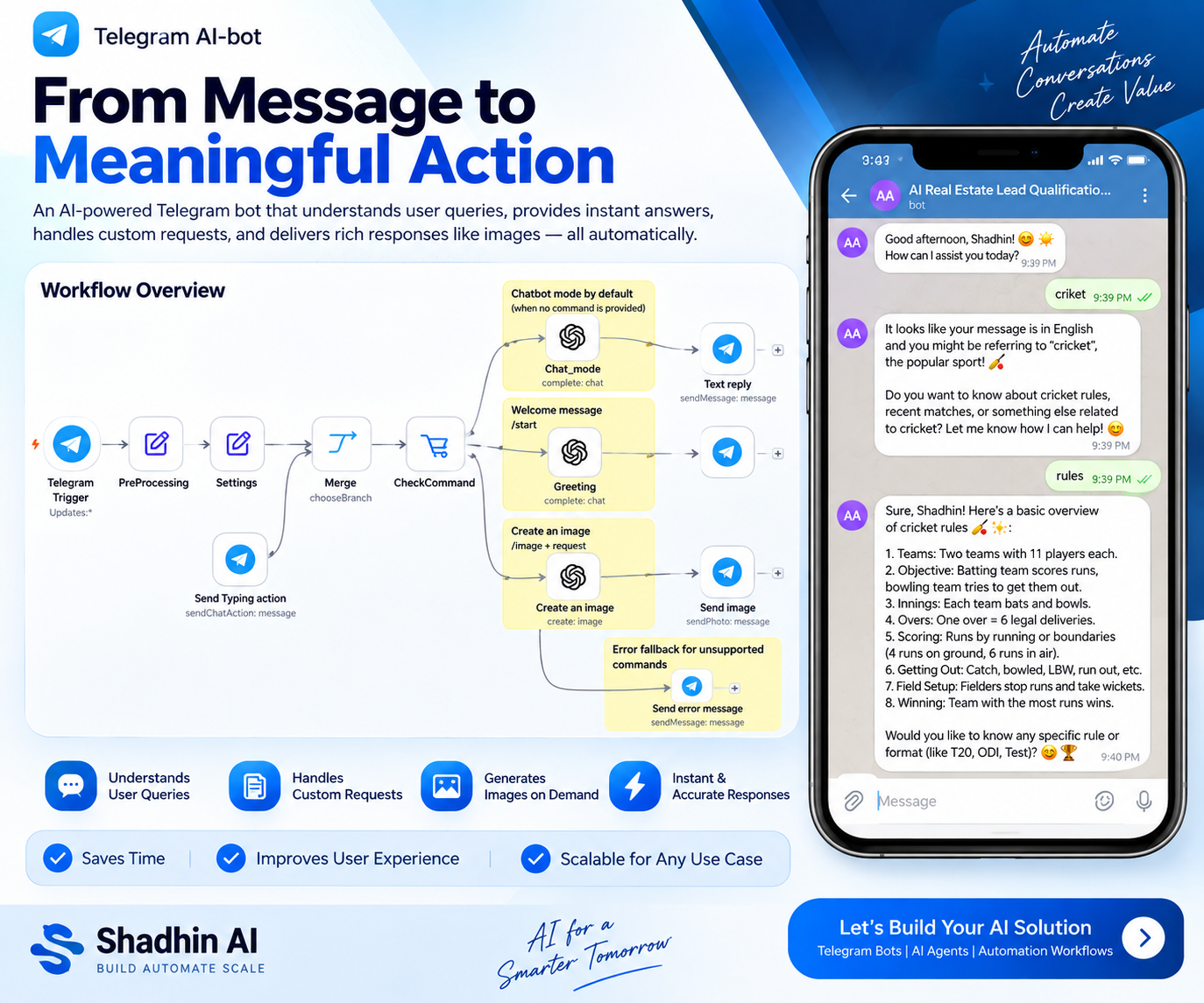
I designed the system as an automated AI workflow where every incoming Telegram message passes through several processing stages.
Trigger
Detection
Processing
Response
🤖 How the AI Telegram Bot Works
1. Receive Message
The Telegram bot receives a message from the user and passes it into the automation workflow.
2. Detect Intent
The system analyzes the message to understand what the user is actually trying to accomplish.
3. AI Processing
The AI model processes the request and determines the appropriate response or action.
4. Execute Action
Depending on the request, the workflow generates text, creates an image, or performs another automated action.
✨ What Can the Telegram AI Chatbot Do?
Natural Language Understanding
Users can communicate naturally instead of relying only on predefined commands.
AI Image Generation
The bot can identify image-generation requests and automatically create and send images.
Instant Responses
Automated responses allow the chatbot to handle conversations without manual intervention.
Error & Fallback Handling
Unsupported commands are routed through a fallback workflow instead of breaking the conversation.
⚠️ Challenges I Faced
1. Intent Detection
The chatbot needed to understand what users actually wanted instead of simply matching keywords.
2. Multiple Response Types
Text responses and image-generation requests require completely different processing paths.
3. Command Handling
Telegram commands such as /start needed dedicated logic without interfering with normal conversations.
4. Error Handling
Not every user request fits into a predefined workflow. That's why fallback logic is essential for reliable automation.
5. User Experience
The bot should feel responsive and provide feedback while processing requests.
💼 Why AI Telegram Chatbots Matter for Businesses
The same AI chatbot architecture can be adapted for many business automation use cases.
Customer Support
Answer repetitive customer questions automatically.
Lead Qualification
Collect information and identify qualified leads.
Appointment Booking
Help customers book appointments through automated conversations.
Business Automation
Reduce repetitive manual work and improve operational efficiency.
💡 The Biggest Lesson
This project helped me explore how AI agents, generative AI, Telegram bot development, and workflow automation can work together to create practical business solutions.
🚀 What's Next?
There are several ways this system can be expanded in the future:
- CRM integration
- Lead capture and qualification
- Database memory
- Voice message support
- Human handoff
- Appointment scheduling
- Analytics and reporting
- Multi-agent AI workflows
Build Smarter. Automate More. Scale Faster.
I'm building AI-powered automation solutions that help businesses reduce repetitive work, improve customer experience, and scale their operations.
Explore AI Automation →